
Basmati Rice
Recipe by Savin Kumar Kapoor
White basmati by the absorption method: rinse, soak for 30 minutes, two parts water to one part rice. Grains that grow long and stay separate.
Side dish · Indian · Vegetarian · Mild · Rice · Classic
- Prep35 min
- Cook20 min
- Servings4
- DifficultyEasy
- Ingredients3
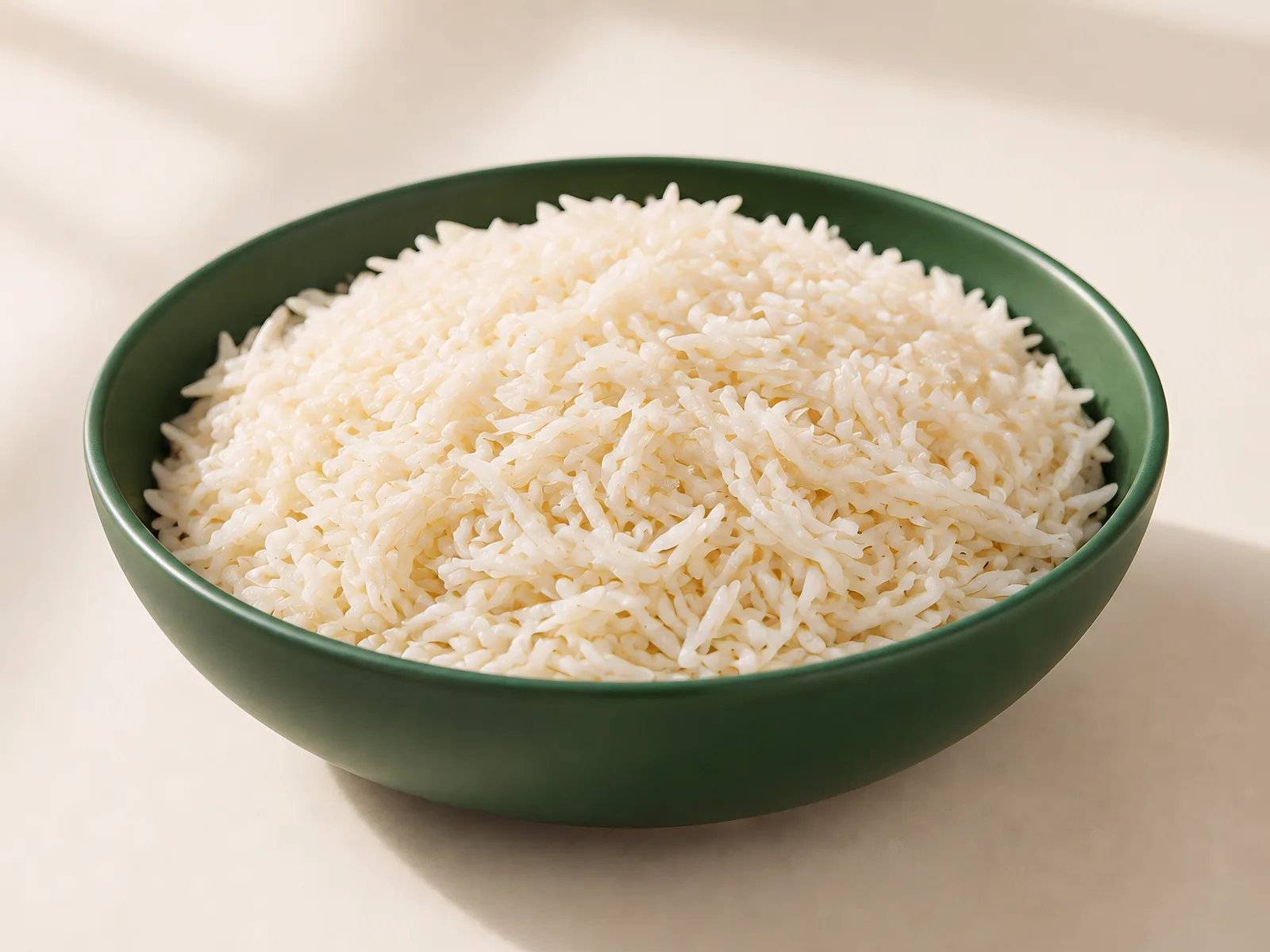
What it should be like
The rice smells faintly nutty and tastes mild, it carries a dal or a curry instead of drowning it. The grains are visibly longer than before cooking, have a matt sheen and come apart one by one; Madhur Jaffrey describes cooked basmati as it should be: like brothers, close to each other but not stuck to each other. Under the fork the rice falls loose without breaking, and nothing sticks to the bottom of the pot. With ghee and cumin a warm, earthy smell is added, the first thing you notice when the lid comes off.
Ingredients
Serves 4.
- 1 tspSalt
- 575 mlWater
Preparation
Measure and rinse the rice: put 240 g of white basmati in a sieve and rinse under cold water until the water runs clear. Do not rub the grains with your hand while rinsing.
It is going right when: After three or four changes the water runs clear instead of milky. The cloudiness is starch dust that forms while the dry grains rub against each other in storage; left on, it makes the grains stick. White basmati grows longer as it cooks and stays separate. Parboiled basmati (golden sella, golden yellow) works just as well and is more forgiving: it breaks less and barely sticks.
Soak: cover the rice with cold water and leave it for 30 minutes. Then drain it and let it stand briefly in the sieve. The soaking water is thrown away, not cooked with the rice.
It is going right when: The grains now look matt white instead of glassy and can be crushed between your fingers. Soaking draws water into the outer layers of the grain: the rice then cooks faster and more evenly, grows longer and breaks less often.
Set it up: put the drained rice into a pot with a well-fitting lid, together with 575 ml of fresh water and the salt.
It is going right when: 575 ml is twice the volume of the rice. In a covered pot exactly that much water leaves as steam and is taken up by the grain, so nothing is left over and nothing is missing at the end.
Bring to the boil, then leave it alone: bring to the boil uncovered, turn the heat straight down to its lowest setting, put the lid on and leave for 12 minutes. Do not stir and do not lift the lid during this time.
It is going right when: After the 12 minutes there is no water left in the pot, and small holes show on the surface — the channels the steam escaped through. The grains are noticeably longer than before.
Rest and fluff: take the pot off the heat and leave it covered for 5 minutes. Then loosen the rice gently with a fork.
It is going right when: The grains come apart one by one and fall loose. The fork lifts the rice rather than pushing it.
Jeera rice variation: heat 2 tbsp of ghee in the pot, add 1 tsp of whole cumin seeds and 1 bay leaf (tej patta) and wait until the seeds smell fragrant. Toss the drained rice in it for half a minute, then add the water and salt and carry on from step 4.
It is going right when: The seeds hiss quietly, rise and turn a shade darker, and the smell becomes nutty. This is what whole spices are for: their aroma sits in fat-soluble oils and only passes into the dish in hot fat, not in water.
Variation with the cooking water poured off: bring 2 litres of water to the boil with the salt, add the washed and soaked rice and boil uncovered for 8 to 10 minutes. Then drain through a sieve and let it stand.
It is going right when: A grain pressed between your fingers still has the faintest bite when you drain it; it carries on cooking in the hot sieve. This is how Tarla Dalal cooks basmati in a pan. The German Federal Institute for Risk Assessment names this preparation — washing and cooking rice in plenty of water and pouring off the excess afterwards — as one way of lowering the inorganic arsenic in rice you cook yourself.