
Chapati (Roti)
Recipe by Savin Kumar Kapoor
Chapati, the Indian flatbread: atta, water, salt and a spoon of ghee, and eight breads from a pan. No oven, no yeast.
Side dish · Indian · Vegetarian · Mild · Bread · Classic
- Prep45 min
- Cook20 min
- Servings4
- DifficultyMedium
- Ingredients4
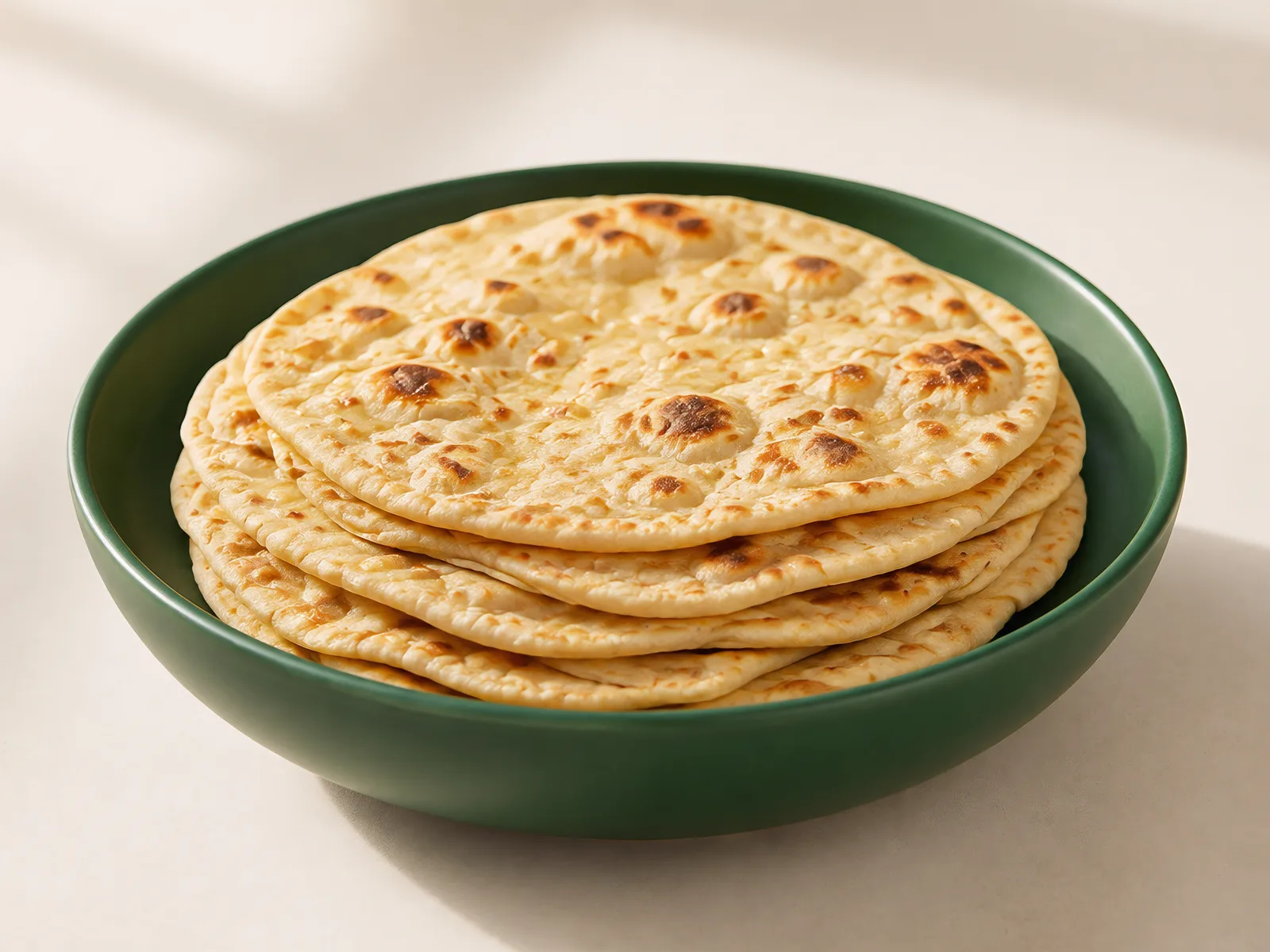
What it should be like
A good chapati is flecked light brown on a smooth surface, neither whitish nor black. It smells of wheat and tastes faintly sweet and nutty from the whole grain — more so than white bread, but mild enough not to cover anything up. You can fold it without it breaking and tear it easily with your fingers; it is soft rather than leathery, and it does not chew like rubber. It is best warm. Serve it with dal, a vegetable dish or a pickled vegetable — and it replaces cutlery: tear off a piece and use it to scoop.
Ingredients
Serves 4.
- 1 level tspSalt, 5 g
- 200 mlWater, lukewarm, a little more if needed
Preparation
Dissolve the salt in the lukewarm water. Put the atta in a wide bowl and pour in the salted water a little at a time, mixing with your hand from the outside in until all the flour has come together.
It is going right when: The dough takes up all the flour, the bowl comes clean as you work, and nothing sticks to your fingers.
Add the tablespoon of ghee and knead the dough with the heel of your hand for three minutes, until it is smooth and supple.
It is going right when: Press it with a fingertip and the dent springs almost all the way back. The dough is soft but not sticky, and it does not tear when you pull it apart.
Brush the dough with a thin film of ghee, cover it with a damp kitchen towel and let it rest for 30 minutes at room temperature.
It is going right when: After half an hour the dough rolls out without shrinking back.
Divide the dough into eight equal pieces and roll each between your palms into a ball. Keep the balls under the damp towel and take out only the one you are about to roll.
It is going right when: Eight balls of about 65 grams, all the same size, under the towel.
Heat a cast-iron pan, a tawa or a heavy non-stick pan over medium-high heat, with no fat in it. A tawa is the flat, rimless iron pan every Indian flatbread is baked on; an ordinary frying pan will do.
It is going right when: A drop of water hisses away at once, and the pan is not smoking.
Dip a ball in atta and roll it out from the centre with light pressure into a circle of about 18 centimetres. Pat off the excess flour between your palms. Turn the heat down one notch while you roll, and back up before you bake.
It is going right when: The bread is evenly thin all over, about two millimetres, and the rim is no thinner than the middle.
Lay the bread on the hot pan and leave it for 20 to 30 seconds without moving it.
It is going right when: Small blisters rise on the upper surface, and the underside is pale with a few light brown spots.
Turn it and bake the second side for 20 to 30 seconds, until light brown spots appear. Then turn it once more and press all over it with a dry, bunched-up kitchen towel, rotating a little between presses, for 10 to 20 seconds.
It is going right when: The bread lifts under the towel and puffs up like a small balloon. This is the moment that makes it soft: steam from the water in the dough cannot escape between the two baked layers and drives them apart. It sinks again as it cools, and that is as it should be.
Brush each finished bread with a thin layer of ghee straight away and put it under a tea towel. Wipe the pan quickly and carry on the same way with the next ball, until all eight breads are stacked up.
It is going right when: Under the towel the stack stays soft and pliable. The towel takes up the steam, so the breads turn neither dry nor soggy.